Monday, May 27, 2019

Hamlet on Electronovision

A recent trip to the public library DVD shelf led to the discovery of a new-to-me HamletRichard Burton's Hamlet.  While I had seen the DVD offered on Amazon, purchasing another edition for the personal collection never quite resonated.  Finding it available to borrow for free, however, was a huge win!

The performance captured on film was one done live in 1964 at the Lunt-Fontanne Theatre.  The DVD title refers to the lead actor, Richard Burton as Hamlet.  I thought it odd that it was identified as his Hamlet, and not the playwright's or even the director's (Sir John Gielgud).  The rear of the DVD case holds remarks from the director.  He calls it "a Hamlet acted in rehearsal clothes, stripped of all the extraneous trappings...This performance was conceived as a final run-through...."

The performance is a refreshingly traditional version of Hamlet.  At a run time of just over three hours, not much of the script is removed (and that which was deleted was not noticeable).  There is minimal set dressing and there are no costume changes, which makes sense when one reads the director's notes.  The preserved video is in black and white.  The video is at times tough to interpret and the audio is at times difficult to decipher, but for such an historical document these problems can be overlooked.

Several things stood out from the production.  It is a very animated performance.  Richard Burton fit expectation perfectly as to what Hamlet should be.  He displayed a terrific emotional range, becoming intense without going over the top.  Some suspension of disbelief is required, though, to imagine a 39-year-old actor in the role.  Also very animated was the audience.  I cannot recall any Hamlet I have seen that received as much applause.  Entrances, exits, scene changes--such a reception is nearly unheard of.  It also was an audience that understood what they were seeing and reacted appropriately, as much a credit to the theatergoers as to the acting company.

The ghost was presented as a shadow on the set, with the voice of the director taking the ghost's lines.  A complete reversal from the most recent Hamlet I saw, which included a ghost able to be hugged, this was a very fitting portrayal.  In the chamber scene, just before the ghost's reappearance, Hamlet compares pictures of Claudius and his father from lockets.  Oddly, there were no lockets, perhaps another indication that this was simply a run-through.

The dumb show was presented before "The Mousetrap."  How did Claudius miss it?  He was too busy canoodling with Gertrude.  The entire scene was well-choreographed, and it actually made dramatic sense.  It was not so much the play that offended Claudius as Hamlet's unseemly behavior during the performance, a great interpretation of the scene.

The duel between Laertes and Hamlet also was well-choreographed, although not terribly violent.  The switch of foils occurs when Hamlet takes the unbated one directly from Laertes and throws his own back in return.  That seemed to be kind of a cop-out.  It left me wondering if the transfer might have been changed in the actual production.

Overall, this version of Hamlet is excellently rendered and well done.  Having just viewed the play on stage one week ago, I did not know whether I would be able to watch it again so soon after (especially a three-hour version).  This one was tremendously enjoyable and restored my faith in live performances.

As a bonus to the performance, the DVD includes an interview with Richard Burton.  He and the interviewer discuss how it was that the film version came to be.  Through a novel process called "electronovision," a live performance was captured on film.  Fifty-five years later, this creation of a "theatrofilm" seems second nature in a world overrun with technology.  At the time, though, the concept had to be both new and exciting.  The recorded play was sent to 1,000 movie houses for four performances held over two days in September (23rd and 24th), 1964.  People were able to go to their local movie house to see a Broadway play on the big screen.  Consider this the ancestor of Fathom Events or NT Live today.  Even the notion that the theatrofilm would be preserved was not expected.  As Burton put it, following those four showings his Hamlet "will never possibly be shown again."  That one is able in 2019 to watch a live performance from 1964 is truly an incredible, one-of-a-kind experience!

Sunday, May 19, 2019

Hamlet at the Diamond

No, our titular hero did not visit the ballpark for a quick nine innings.  This was Hamlet at the Irish Classical Theatre Company (ICTC) in Buffalo.  It was my first visit to the venue, discovered via an Internet search for live performances of Hamlet in the geographic area.  As I would learn, this production had much in common with my last trip to Buffalo to see Hamlet.

The ICTC sent an e-mail notification that the matinee performance of Hamlet would begin with an introductory lecture.  I was happy to bump up my arrival time in order to be able to attend. Conducted by Dr. Barbara Bono, a professor at the University at Buffalo, the presentation's non-pithy title was "Hamlets and Your Hamlet:  A Conversation about Famous Hamlets, the ICTC Hamlet, and Your Hamlet."  The talk turned out to be introductory in nature.  Dr. Bono spoke about how Hamlet is "hugely open to interpretation."  She began with historical information about the play.  Next she compared the film roles as acted by Laurence Olivier, "the contemplative Hamlet," and Mel Gibson, "the Hamlet of action."  Also included were the portrayals by Kenneth Branagh and Ethan Hawke.  Dr. Bono set the stage for the performance we were to see that afternoon.  The set and dress would be modern, and the Fortinbras subplot would be omitted; fairly standard directorial treatments.  She described Hamlet as a graduate student in divinity at Wittenberg, leading me to wonder if she had ever seen David Davalos' play of that name.  At the conclusion of the talk, the floor was opened for questions or for stories about one's "Hamlet."  There was not enough time (or heaven knows, enough interest among other audience members) for me to suck the air out of the room with personal Hamlet stories.  (Thank you, reader, for making it this far.)

The lecture afforded the audience a chance to examine the theatre and the set.  The theatre is not quite in the round.  It is, rather, in the shape of a diamond, a baseball infield if you will. The seating is very comfortable.  I had a front row seat, which was at stage level, in theory a great sight line.  I am not sure about sight lines if one has another patron sitting in front.  Continuing the allusion to baseball, the set consisted of the infield done as a tile floor with alternating dark and light tiles.  There were patches of stone at each corner; think the bases of the diamond.  In addition, at first, second, and third base there were piles of jumbled furniture, much as one would find in one's attic.  There was a wooden frame set up in the shape of a squared-off "U", with the bottom of the "U" at second base.  The frame allowed one to think of walls or doors, even if cast members did not use them consistently as such.

The cast entered, attired in modern dress.  I noticed immediately that Polonius, directly in front of me, had forgotten to tie his shoes.  Hamlet, attired all in black, dragged his own chair on stage while the others used assorted chairs that were already placed.  Hamlet's opening dialogue was a bit unsettling.  It was loud, stilted, and grossly emotive; it did not bode well for the afternoon at the theatre.  Time would tell.

Hamlet's meeting with the ghost of his father provided the first questionable directorial decision.  The ghost had a physical body.  Hamlet and the ghost engaged in hugs and other physical contact.  It was not explained how this could happen.  Were we peering into the inner workings of a deeply disturbed prince who imagined the ability to touch a ghost?  For the moment, we were left to wonder.  Hamlet rejoined his friends and asked them to swear upon his sword, although it was only a knife.

The arrival of Rosencrantz and Guildenstern to Elsinore led to additional directorial oddities.  Their initial meeting with Hamlet consisted of dialogue without discussion of fortune's "privates."  Following, the two were left to sit uncomfortably on paint cans that were produced from the detritus at first base.  There were plenty of chairs on stage.  Why should there be paint cans, and why should they be forced to sit on them?  As a humorous point, it failed.  As a serious plot device, it also failed.  The entrance of Polonius to inform Hamlet of the players came as Hamlet delivered a line about it being a Monday morning.  With all of the lines that had been excised thus far, this throwaway line (which I had to look in a text to find) was left intact.

Hamlet's "rogue and peasant slave" soliloquy was a mess.  It passed from unbelievable to totally unbelievable as Hamlet screamed "O vengeance!" at the top of his lungs.  I recalled a Hamlet lecture from my college days during which the professor played a cassette tape of a version of that soliloquy with a wretched shriek of the same line.  This particular speech lacked any realistic emotion.  Additionally, it was becoming ever more apparent that our Hamlet had trouble with the rhythm of Shakespearean English.  Think William Shatner doing Hamlet...with the stresses in all the wrong places.

The players--both of them--entered.  It was the smallest troupe I can recall seeing.  Budget constraints?  Smallpox?  Whatever the problem, the first player was the same actor who had played the ghost.  Strangely, Hamlet saw him and acted as if he recognized him as the ghost.  This made no sense at all.  The fact that one actor doubled the roles should not have become a plot point.  To wit, the actor played the priest during the funeral scene and seemingly was not recognized there, so why should it have happened at this point?  Odd direction.  The Priam speech and associated dialogue were edited.  Polonius interrupted, but there was no retort about his going to the barber.  It was another example of original Shakespearean humor being removed.

The "To be or not to be" soliloquy was forgettable, again marred by unbalanced and unbelievable delivery.  The nunnery scene began with Hamlet spying the fair Ophelia from across the stage.  The lights dipped, the music came up, and suddenly the two of them met at center stage for a quick dance, likely intended as a flashback to happier days.  For this audience member, it was a flashback to a previous Hamlet.  I knew that I had seen that before--at UB.  (See 3/14/18 post.)  Coincidence?  No.  As it turns out, the two productions share a director.  Learning that fact from the UB playbill answered many questions about this production.  The remainder of the nunnery scene was tolerable.  It was interesting, though, that the letters that Ophelia was returning to Hamlet were already ripped and crumpled.  Perhaps there had been an earlier lovers' quarrel?

On to "The Mousetrap" scene.  How does one remedy a troupe consisting of only two actors?  Put Rosencrantz into the play doing a dramatic reading for the part of the queen.  Oh boy.  There may have been a dumb show.  I'm not sure.  The trio did run out on stage to do something, but I couldn't tell what it was.  Maybe that's how Claudius missed it; he blinked.  My problem was the blocking.  Granted, a performance in the round requires special directorial effort.  It also requires understanding on the part of audience members that they will see faces only about 25% of the time.  For "The Mousetrap," I was unable to see any faces.  Polonius was directly in front of me (midway up the first base line), obscuring the actors in my sight line.  Claudius was in profile, everyone else was back to me or blocked entirely.  This problem completely destroyed any interest in the scene.  It is hard to relate to a character when all you see is the back of his head.  I did enjoy the reaction of the players at the abrupt end of the play.  Fearing for their lives, they fled quickly from the castle.  It is an open question from Shakespeare's original and a good directorial interpretation.  The first act ended at the witching time of night.

The second act provided more of the same.  Polonius was stabbed and managed to walk across stage to die in a sitting position in a chair.  The ghost appeared and enjoyed another hug with Hamlet, although the former was invisible (and incorporeal) to Gertrude.  As Hamlet headed to England, he delivered the "How all occasions" soliloquy.  Why?  Why?  Why?  As with the UB production, there was no context for this with all references to Fortinbras having been omitted.  It became just one more speech, delivered badly.  As Horatio read aloud his letter from Hamlet, Hamlet stood at center stage shadow-fencing.  Why?  Why not?  Ophelia's madness scene was well done, at least for the second half, with artificial plants and genuine emotion.

The graveyard scene used only one gravedigger, so the humorous conversation about the nature of Christian burial was gone.  He merely sang (?) while removing skulls from a cot (?) and setting them up at home plate (?).  Hamlet's interaction with the digger was shortened and also devoid of humor.  The "Alas Poor Yorick" speech came without suitable introduction, and the discussion continued to Alexander but stopped before bungholes.  The funeral consisted of Laertes and Hamlet fighting over Ophelia, who lied on a cot.

The downward slide continued.  Osric was entirely unnecessary.  He came with no hat, so that portion of the dialogue was out.  He seemed to be portrayed as menacing, not foppish, but he had not nearly enough lines to substantiate that characterization.  The fight was very well choreographed, with real swords and an actual fight.  It was suitably violent.  For as well done as the duel was, though, the resolution was unsatisfying.  Hamlet and Laertes both were poisoned as the unbated and envenomed sword somehow cut them through safety gloves and without visible blood.  Gertrude died and ended up on the furniture pile at second base.  Claudius was sliced on both calves, was made to drink from the poisoned chalice, and ended up supine atop the same furniture pile.  Laertes died on the ground between third and home.  Hamlet made it back to first base, emoted some more, declared that the rest was silence (Thank God!), and died atop that furniture pile.  Three hours (less a fifteen-minute intermission) after it had begun, we called it a day.

I had high hopes for this performance.  In the win column were the theatre environment and the choreography of the duel.  In the loss column was the acting, which, excepting Hamlet's chronic histrionics, was generally boring.  Some directorial decisions worked while others fell flat.  When all was over, this was simply a more stylish rehash of the director's previous effort at UB and one that showed many of the same issues as its predecessor.  No home run, it was nearly a strikeout.

Tuesday, April 16, 2019

R&G in CNY

The occasion of Record Store Day 2019 found me making a trip eastward to revisit the CNY Playhouse.  (Foul!  No non sequiturs.)  Last year it was their production of Hamlet.  (See 5/23/18 post.)  This year it was their production of Rosencrantz & Guildenstern Are Dead.  Unlike its predecessor, however, this year's attempt was not nearly as fulfilling.

My opening salvo in last year's review was regarding the venue.  The Shoppingtown Mall was even more deserted than it had been previously.  In fact, as I walked through it before the theatre doors opened, I discovered entire corridors devoid of stores and people.  It was a tad unsettling to say the least.  At least the bird droppings of last year had been cleaned up.

Part of the interest in seeing R&G live for the third time was to see how it would be handled vis a vis its Shakespearean counterpart.  The other times I had encountered R&G, in Oswego and Rochester, it was a part of repertory production.  As such, the casts and sets were similar.  With a one-year separation between CNY's shows, I wondered if this would be the case here.  It was not.  The set consisted of a largely bare stage with a stylishly torn curtain at the back and three large trunks/boxes at each side.  While a few of the actors had appeared in last year's production (with the director of R&G having played Rosencrantz), none were reprising their previous roles.  So this was an entirely separate work.

After pre-show audio consisting of a looped recording of ambient music and an actor speaking "The time is out of joint," the show began with our protagonists on stage, tossing coins.  Their costumes were modern items coordinated to look period--unremarkably adequate.  Unfortunately, the same could be said of the performances of Rosencrantz and Guildenstern.  The actors expressed good diction and generally were in command of their lines, with only a few stumbles noted.  As characters, though, they were unremarkably adequate; not bothersome, but not terribly interesting either.  The witticism for which the original play is noted became a casualty of the tepid delivery.  Yet, these roles were the highlight of the evening.

The remaining performances ranged from unpleasant to awful.  The Player was simply boring.  The direction called for the Hamlet roles to be performed as egregious slapstick, a decision that was questionable at best.  Claudius, for instance, ended up with lipstick on the right side of his head after a kiss from a slobberingly sottish Gertrude, and the lipstick remained for the evening.  The portrayal of Hamlet was dreadfully overdone.  Polonius, in a cheap-looking silvery-white wig, delivered most of his lines with his eyes closed, as if he could not bear to look.  I could not blame him on that count.  For a play that is reputed to be comedic, there was hardly any legitimate humor evident.  The actors merely chewed the scenery, and badly.  It was telling that the most audible laughter came from the rear of the house, where the crew were stationed.

The play was performed with one intermission.  The first intermission in Stoppard's original script was handled as a fade to black with some Hamlet lines piped in over the sound system.  The lights came up and went into the playwright's Act II.  The intermission in the CNY production came within Stoppard's Act II, at the blackout following the mock death scene and Guildenstern's speech about acting death.  It was roughly 90 minutes after the show had begun, although it had felt much longer.

The intermission usually provides the audience a chance to stretch, to refresh, and to reset itself for what is to come.  In this case and for this author, it was a chance to escape.  The realization that at least another hour remained of the advertised running time was too much to bear.  There was nothing about Act I that caused me to care in the least what happened to the characters.  The time would be (and was) much better spent in heading for home.

So I have no idea how this production of R&G ended.  Did our protagonists manage to avoid their title fate or did they lose their heads?  Did it really matter?  In my estimation, not particularly.  To borrow a phrase from the Ambassador, who may or may not have appeared the end of the play, the sight was dismal.


Sunday, September 16, 2018

Shakespeare at The Avyarium

The 2018 KeyBank Rochester Fringe Festival is upon us, and with it some blog-relevant offerings.  The first of those that I attended was entitled One Last Bow, Eulogy For the Bard.  It was presented at a new venue for the Fringe, The Avyarium, which could be characterized best as a venue in progress.  The room is a reclaimed warehouse space that is still bare.  The furnishings consisted of a circular stage almost but not quite surrounded by chairs.  Think theatre 83% in the round.  The chairs were wooden contraptions, four seats to a rack, ostensibly saved from a dumpster.  Based on the comfort level, they should have been left there.  One (at least this one) hopes the finished room has more comfortable seating options, as well as climate control.

The play involved several of Shakespeare's characters delivering a eulogy for their creator, using the words that he gave to them.  Present and accounted for were Iago, Juliet, Shylock, Othello, and Hamlet.  The costuming differed in style with a common color theme--black.  The outfits were particular to the character:  Hamlet in princely garb, Juliet in a black evening dress, Shylock in a robe, Othello in black top and stretch pants (?), and Iago in black T-shirt and jeans.  (It appeared that the actor who played Iago may have been an understudy, as he spent the evening reading lines from a script.  The costume may not have been what was intended.)

The play opened with Shakespeare on stage, speaking in language that fit the occasion and seemed to be original.  From off-stage we heard his characters speaking famous lines.  Shakespeare lied on a tabletop and appeared to die.  The action then moved to the characters, delivering lines for which they are noted.  Iago functioned as a sort of emcee.  Hamlet led off with...guess which one.  Juliet followed with the "Tis but thy name that is my enemy" speech.  Shylock followed with a fumbled speech of money, flesh and Christians, which appeared to be a mash-up from Act I, Scene 3 of The Merchant of Venice.  Othello closed out Round 1 with his "Her father loved me" speech.

The characters decided to go for a second round of speeches, at which point Iago left the stage and did not return.  It was unclear why.  Othello led off with the "Put out the light" soliloquy.  Shylock followed with his "If you prick us do we not bleed?" speech.  Juliet delivered her death speech and feigned suicide.  Hamlet closed out the round with the "How all occasions" soliloquy.

For some reason, a seemingly dead Shakespeare woke up at this point.  His nap or near death experience must have inspired him, as he delivered the "All the world's a stage" soliloquy from As You Like It.  He addressed each of his characters (sans Iago), who then left stage.  The play ended with Shakespeare lying down a second time (perhaps dying again?) as the lights faded to black.

I'm not quite sure what it all meant.  The actors delivered their lines mostly adequately, but there was no sympathetic connection between actors and lines or between cast and audience.  The entire exercise was disjointed and seemed to be only an excuse for roughly thirty minutes of oration.  It was, to toss out another quote of the Bard, "wondrous strange."

As it turned out, it was also my only blog-relevant show of the festival.  Although I had planned to attend another, it would have meant a second trip to The Avyarium.  I simply could not bring myself to return to the venue in its present level of discomfort.  So for Fringe 2018, all's well that ends.


Wednesday, May 23, 2018

Hamlet (w/o the Cha-Cha-Cha!)

One week after the last Hamlet adventure, another return trip led to another performance.  This time it was a visit to the Central NY Playhouse, the location of Hamlet Cha-Cha-Cha! in 2013.  (See 8/19/13 post.)  Even without the Durante-esque excitement, the new production yielded a solid and entertaining performance.

First, a note about the venue.  The Playhouse is located in what once was Shoppingtown Mall.  As I arrived, it was to the sight and sound of a patron lying in the parking lot moaning.  Thankfully, security was on the scene.  The interior of the mall is largely vacant space; even the public library has moved out.  The Playhouse and the Regal Cinema were seemingly the only tenants that were open during my visit.  One of the few signs of life was the bird droppings on the railings near the Playhouse, left by the birds who have taken up indoor residence.  Later in the evening, the theatre manager directed patrons to restrooms, located in what used to be the food court.  The vacant, hulking setting made the entire performance feel like a play-within-a-play.

So much for that.  On to the production.  The stage set consisted of two levels--the upper level was four steps above the lower, which was on the stage.  Seating for audience members is all on one level at tables, which led to views obstructed by other patrons' heads, especially during Hamlet's death scene.  There were a few red cloth backdrops to give the hint of a castle interior.  A bench downstage was the sole piece of stationary furniture, with other pieces moved onstage as needed.  Stage left contained a tomb within ivy-covered iron gates, adding a funereal tone to the set.  Costumes were modern dress, with dark colored clothing contrasting with bright red armbands and sashes.  There was a feel of Nazi Germany in colors and mood, lack of swastikas notwithstanding.  Claudius had the unmistakable bearing of Reinhard Heydrich, down to the blond hair, and he had his own sneering SS officer at his side for much of the action.  The director played up this idea of a violent military state, at times going overboard with it.

The play opened as the play should open, namely with Francisco and his mates on the watch.  The ghost appeared as an apparition; in this case it was an image of a man in a white suit projected on a screen.  From there we moved to the court interior where Claudius addressed his subjects.  Polonius, bald and with goatee, was clad in a curious suit which was half-grey and half-black, hinting at a half-neutral, half-enemy character.  Laertes was given a definite family resemblance, also bald and with a goatee.  Upon news that Hamlet would not be returning to Wittenberg, clear distress on the faces of Laertes and Ophelia was evident.

Hamlet's first soliloquy belied something that would be apparent all evening.  As part of this performance, some of the original Shakespearean language was re-translated into a modern feel.  It was unclear if this was a conscious decision on the part of the director or if it was a sign of lines not having been memorized fully, but these textual differences were notable.  While they did alter the meter, they did not alter the feel of the play.  In fact, they likely were only apparent to one who is intimately familiar with the source text.

Laertes and Ophelia entered the stage from the rear of the theatre as brother instructed sister prior to his departure.  The subsequent interaction between Polonius and Laertes was played for humor, leading this audience member to laugh aloud.  It was a well done scene, showing Polonius for a caring, foppish, disciplinarian father and Laertes for a long-suffering son.

The meeting between Hamlet and the ghost included some peculiarities.  The ghost transitioned from apparition to actual actor with a jump and loud landing on stage, something a ghost would not have done.  The entrance should have been muted a bit.  Hamlet came to the meeting carrying a rifle, not a sword.  That alteration fit the context of the play, but leaving in the line about swearing "on my sword" did not.

As with the recent Lyric Theatre production (see 5/13/18 post), an invented interlude between Hamlet and Ophelia took place.  The scene, with no trace of madness, made obvious the romantic relationship between them.  Following Polonius' conversation with Reynaldo--cleverly staged as a phone call!--Ophelia burst in "affrighted."  Hamlet stood upstage left, mouthing the words that Ophelia spoke as if the two had planned the entire script together.  Ophelia became a conspirator with Hamlet, creating a story of antic disposition.

Rosencrantz and Guildenstern came on the scene and, as at the Lyric Theatre, one was male and one was female.  Unlike that staging, though, the female role was not played as a floozy.  Instead, both were played as legitimate characters.  It was odd, though, when they were called "good gentlemen."  Was the role male or female?  No matter.  It was not an egregious fault.

Polonius' description of Hamlet's apparent madness was played for humor, with Polonius every bit the verbose fop.  Claudius and Gertrude drank wine to help them get through his monologue, and even the servant who brought the wine got into the act.  His dozing off was an added humorous touch for a scene very well done.

The entrance of the players was altered from Shakespeare's original.  Polonius did not introduce them.  There was no speech about Priam.  This made the "rogue and peasant slave" soliloquy awkward as there was no basis at all for it.  The soliloquy itself was heavily edited to mitigate the confusion.

The discussion between Claudius and Polonius about Hamlet was a key piece of the development of Ophelia's character.  She discovers that her lie of Hamlet's madness is leading to their investigation of her boyfriend.  She has become trapped in the plot.  The nunnery scene, then, gained an entirely new dimension.  The whole interaction was staged for the benefit of Claudius and Polonius' spying ears.  Ophelia gestured throughout the interaction to alert Hamlet that the spies were present, ratting them out as it were.  It backfired, though.  Hearing that Hamlet would be sent to England caused an emotional response.  Her conspiring was the cause of her boyfriend's expulsion.  She was hoist with her own petard, to borrow a phrase.

"The Mousetrap" took place after edited directions from Hamlet to the players.  The dumb show was removed, and the murder was transplanted from Vienna to Venice.  The scene itself was relatively mild, although Ophelia's emotion at the pending departure of her boyfriend was apparent.  It gave a different dimension to her outburst.  Following the call for lights, Rosencrantz and Guildenstern appeared clad in red armbands, a sign that they had become allies of Claudius.  Hamlet went off to his mother's chamber, and the first part ended with a dreadful addition to the text.  The players were brought back on stage and executed for their disrespect of Claudius.  It was a violent and entirely unnecessary invention.  Eighty minutes after the play had begun, we went to intermission.

The second part began with Claudius and Hamlet's soliloquies.  They were oddly blocked, with the usual question present of how one cannot hear the other considering their physical proximity.  Guns were substituted for swords.  Hamlet carried a pistol, which he brought with him to Gertrude's chamber.  He brought it out to shoot Polonius, a modern and not unique alteration.  The subsequent search for Polonius was needlessly violent, with Hamlet being savaged by Claudius' SS man.  Perhaps it was the overplayed violence that caused Hamlet to flub the line about finding Polonius--If your messenger find him not within two weeks, seek him in the other place yourself.  Oops.  Fortinbras and Norway were left in this production, so the retention of the "How all occasions" soliloquy made sense.  Hamlet went off for England.

Ophelia was a mess in the madness scene, and that is a compliment.  She was suitably emotionally distressed.  An oft-posed question is the cause of her unhappiness.  The relationship between Polonius and Ophelia seems not to be an overly loving one.  Hamlet has shunned her, but the depth of their relationship is not clear.  Polonius dies, but he and his daughter seemed not to be close.  Why such a momentous emotional break?  In this production, the question was answered interestingly and well.  Ophelia and Hamlet were co-conspirators in his antic disposition.  Her lies to Polonius and her scheming with Hamlet led to Hamlet's expulsion and subsequently to Polonius' death.  How could she not feel responsible?  The madness was given cause.  Later, her suicide was displayed vividly.  As Gertrude delivered the account of Ophelia's death, a flashback was shown on the video screen depicting quite clearly that her death was suicide and not accident.  It was good for those who like resolution, but it also removed the doubtful nature of her death that Shakespeare had written.

Laertes and Claudius plotted Hamlet's death.  As a sign that Laertes would be ruled by Claudius, the former received a red armband from the latter.  Gertrude entered upstage during the conversation, and thus she heard the entire plot of the poisoned chalice.  She delivered the aforementioned account of Ophelia's death.

The gravedigger scene was left nearly intact, although an above ground tomb was a bit confusing.  The churlish priest entered in a lab coat, a very odd costume choice.  The altercation between Laertes and Hamlet was as violent as one might imagine given the director's predilection for violence.  Hamlet's subsequent account of the deaths of Rosencrantz and Guildenstern was much edited.  Osric was annoyingly fun, a well portrayed character in a well portrayed scene.

The duel was relatively straightforward, ironic considering the violence that had surrounded previous scenes.  Following a tearful moment with her son, Gertrude drank the chalice which she knew to be poisoned, thereby committing suicide.  The usual characters died, and the rest was silence.  Fortinbras entered to see much amiss, and he was notably very excited at the sight.  The lights faded and nearly three hours after it had begun, the play was over.

Overall, I found this to be a very creditable production.  The acting was on all counts quite good.  The actors were believable in their roles and played them well.  While some directorial decisions were questionable, none of them were severe enough to sink the production.  I applaud the entire company for an interesting and enjoyable evening!

Sunday, May 13, 2018

A Lyric Hamlet

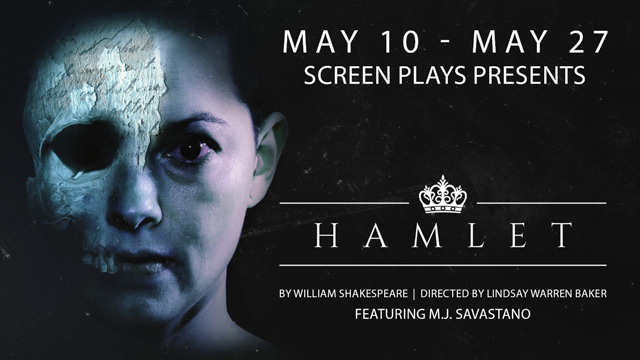
Hamlet returned to Rochester and to the Lyric Theatre.  While the last appearance was a tribute of sorts (see 10/2/16 post), this was a full-fledged production courtesy of Screen Plays.  It was an uneven production, characterized by performances both good and bad and some questionable direction.

The setting for the performance was the Lyric's Cabaret Hall, the smaller of their two venues I have visited (and the same one that held the aforementioned tribute).  Most of the action occurred on a thrust stage with a tiled floor, while some of the action moved offstage or onto the upper balcony around the seating bowl.  The set, described vaguely in the playbill as Elsinore in "The Present and The Past," consisted of some chairs, a small table, and a chaise longue.  Audience seating was on uncomfortable, plastic folding chairs.  Seat cushions were offered to those who chose to alert via smart phone the usual social media platforms of their attendance.  I saw no seat cushions among the audience, a sign that the enticement was not enough.  Costumes were modern dress, formal or casual depending on context.

While reading the playbill, my optimism at the evening's show was put on guard.  It began with the title of the dramaturg's essay, "On Gender, Hamlet, and Theatre in the 21st Century."  This production included a "woman playing the role of Hamlet," a phrase the dramaturg quoted and then denounced as "troublesome in a variety of ways."  Having seen numerous productions with female leads, the essay struck me as defensive protesting.  If the play is done well, the gender of the actor is irrelevant.  It's when the director starts to reinvent Shakespeare that problems arise....

The play opened in the light; upper windows and early evening sunlight prevented the room from being put into darkness.  While the room was not put into darkness, the play was with an invented scene to begin.  Horatio opened with his speech from the end of the play, that of recounting accidental judgments, casual slaughters, and the like.  Meanwhile, an entire cast of ghosts emerged to frighten Horatio.  That oddity concluded, we dove into action as Claudius addressed the royal court about green memory.  Shakespeare's entire castle sequence opening was omitted.  Sorry, honest Francisco!

The initial appearance of Horatio (another female cast as a male) alerted the audience to a directorial gimmick that was to drag down the performance throughout.  As discussed in the director's essay in the playbill, the entire play was taking place in Horatio's mind as he read about the action from records that Hamlet had kept in life, his "tables."  Thus, the "recounting" that Horatio mentioned in the invented prologue was given literal meaning.  The directorial decision necessitated Horatio's presence on or about stage almost the entire evening, standing back as an observer, reading the action we were seeing.  (Could Hamlet have recorded events he never saw?  Best not to ask.)  This upstaging was distracting.  To worsen matters, the portrayal of Horatio was a maudlin disaster.  The character spent most of the evening looking as if he was about to burst into tears. While an interesting idea in theory, in practice such nonsense cast a pall on the rest of the action.

Back to the royal court.  Claudius spoke in an even, emotionless, understated tone, much as he spoke all of his lines.  There was no mention of Norway or Fortinbras, highlighting one way in which the play would be edited.  (Thankfully, the "How all occasions" soliloquy was removed accordingly and not forced as in the recent UB production.  See 3/14/18 post.)  Polonius sought leave for his son.  The portrayal of Polonius was one of the evening's highlights--subtle, scheming yet not overly foppish.  The handlebar mustache (a la Snidely Whiplash) and goatee gave his costume a bit of unstated duplicity.

Hamlet entered, clad all in black.  With close-cropped hair and unisex clothing, the gender of the role was not nearly as distracting as the dramaturg's essay had anticipated.  In fact, the gender issue was a non-issue.  M.J. Savastano did a very creditable job in the title role.  Her Hamlet was Hamlet.  He was well-performed and generally believable.  While at times the delivery of lines seemed a bit forced, the role itself was unmarred by casting decisions.  The histrionic car wreck that was Horatio was far more of a problem.

The action proceeded generally according to Shakespeare until an invented scene depicting an interlude between Hamlet and Ophelia.  Polonius observed the interaction from the upper level.  When he approached Ophelia, she realized she had been caught.  To cover the brief liaison, she claimed to be "affrighted."  The speech that followed then became a lie to cover her actions.  This unfortunate decision turned Ophelia into a deceiver, no better or more sympathetic than the other characters.  It also eliminated Hamlet's early displays of antic disposition.

The appearance of Rosencrantz and Guildenstern was enough to turn this audience member's stomach.  Both characters were portrayed by women; not an issue in itself.  One of them was dressed as a man, in a not-terribly-modern suit.  The other was dressed as some sort of, to be polite, floozy.  What exactly was the point?  I have no idea.  It is one thing to cast a female in a male role.  It is quite another to change the role entirely.  If the thought was to generate comic relief, it failed completely.  Fortunately, the two characters are minor enough roles that they were not on stage much.  It's a shame they had to be on stage at all.

Another questionable directorial decision involved the reordering of scenes from Shakespeare's Acts II and III.  Polonius hid behind an arras.  Hamlet delivered the "To be" soliloquy.  The nunnery scene followed.  Rosencrantz and Guildenstern entered (ugh).  The "rogue and peasant slave" soliloquy came next.  Claudius urged vigilance for "madness in great ones."  Cut to Hamlet, urging the player to "speak the speech...trippingly."  Time was out of joint, literally.

The progression was a mess.  Consider.  This Hamlet believes Polonius to be behind Ophelia's returning of favors.  Hamlet is angry, as evidenced by the nunnery scene (which Horatio watched from the balcony!).  Then we cut to "words, words, words," and see Hamlet interact with Polonius in a playful fashion.  The "To be" soliloquy's placement as the centerpiece of the play was gone.  The juxtaposition simply did not work. 

The arrival of the players injected more confusion into the proceedings.  For some reason, it took three players to deliver the speech about Priam.  It was delivered as comedy, destroying the idea of red face and tears.  This then muddies the rationale for the "rogue and peasant slave" soliloquy.  If the actor does not deliver a believable, emotional speech, then how would Hamlet have a suitable contrast to describe?  No matter, as the speech was edited heavily.

The blocking for "The Mousetrap" had Claudius, Gertrude, and Polonius on one side of the stage and Hamlet, Ophelia, and Horatio on the opposite side, a great way to display the two factions.  There was no dumb show for Claudius to miss.  The play-within-the-play was well acted.  Claudius' degree of displeasure was not evident as the tone of his lines was unwavering throughout.  His soliloquy was bland, and Hamlet's response was delivered on stage level instead of using the balcony.  Hamlet went to visit his mother, Polonius was stabbed, the son wished Gertrude good night, and, roughly ninety minutes after they went up, the lights faded.

During the short intermission that followed, a fellow audience member asked if I was a critic reviewing the play.  (The notepad and pen gave me away, I guess.)  After I replied that I was taking notes for myself, she asked me a question:  "Who was the woman hanging around the king?"  Happy that someone else had noticed that oddity, I replied that it must have been an awkwardly placed, unnamed attendant.  The character had no lines and just stood around looking out of place.  I suggested that it might have been the original's Cornelius or Voltemand, who were not named in the character list.  She asked if it was Osric, and I said that it probably was not as he appeared much later.  Little did I know...

Meanwhile, Horatio reappeared.  In character.  During the intermission.  Sitting off to the side, reading from Hamlet's tables.  So does that mean that Hamlet wrote about an intermission in his book and we were all part of the play in Horatio's mind?  Again, best not to ask.

The second act began with another invented scene.  We saw Horatio deliver to Ophelia the news that Polonius had died.  Terrific.  Another reason to see Horatio get teary-eyed.  Simultaneously, on the upper level, Hamlet read the letter calling for his death while Laertes read a letter, likely recounting the death of Polonius.  Why create new scenes?

Ophelia's subsequent madness scene was one of the mildest I have seen.  It was not overdone emotionally; in fact, quite the opposite.  She was very well-groomed for being mad.  Her songs were plentiful, and her flowers were pages torn from a diary.  There was no screaming or sobbing.  Considering the well of water that was Horatio, Ophelia's understated performance was a welcome relief.

A sailor appeared on stage to deliver letters from Hamlet.  It was a very poor attempt at comic relief.  The letter to Claudius was delivered.  He and Laertes hatched their plot, while the awkward attendant stood behind and listened to the entire discussion.  A third conspirator!

The gravedigger scene, Shakespeare's intended comic relief, was terribly unfunny.  There was no grave; there was a table covered in a black cloth and placed atop another black cloth.  Some "digging" occurred, which involved removing physical remains from under the stage and placing them into a wooden crate.  The curious aspect of the scene was one of casting--the actress who played Ophelia was one of the gravediggers.  It worked for the Public Theater (see 8/21/17 post).  How would her body be placed into the grave this time?  The laughable answer--she was cremated!  Her ashes were brought out in a urn.  (Historical and Christian discussions of this nonsensical plot twist must be put aside.)  The irony of the gravedigger who once was Ophelia carrying the ashes that once were Ophelia was not lost on this audience member.

The appearance of Osric added another new directorial dimension.  Osric was the awkward attendant who had been present throughout the evening, including during the discussion of the conspiracy.  (That audience member had been right!)  Osric's entrance was marked by confusion when the hat, which should have been off his (her) head, was on it.  The duel that followed was straightforward if unimaginative.  Somehow Laertes was stabbed through his protective vest and died.  Osric ran out a side door to director knows where.  The king showed no emotion when his plot was discovered.  The usual players died, and the rest was silent (silence?).

Or was it?  We were dragged back to the beginning of the evening as the prologue was re-staged.  Horatio delivered the lines with which he had opened the play and the ghosts reappeared.  Things were brought full circle.  Then the 45-minute second act was over.

This Hamlet had a bit of a red herring aspect.  The supposed major point of controversy, having a "woman playing the role of Hamlet," was not contentious at all.  It was not the gender of Hamlet that caused this critic difficulty.  That non-issue merely distracted from the more serious problem, namely the substitution of the director's judgment for that of the playwright.  Inventing scenes, rearranging the order of others, changing characters--these are the true difficulties here, the true flaw of this tragedy.  The effort was muddled by these non-accidental judgments, which ultimately left this production "fall'n on th' inventors' heads."

Thursday, March 22, 2018

P.C. Hamlet

Recently I was pointed in the direction of an article entitled "The Modern Major Remodelling of the Gilbert and Sullivan Operas."  It appears in the February 2018 issue of New Theatre Quarterly (see citation below).  The author, Prof. Alan Fischler, was the inspiration for this blogging venture 177 posts ago.  It is only fitting that his new article is the subject of one of these posts...and that it intersects with the underlying theme of this blog.

The article describes the effects of political correctness on several of Gilbert and Sullivan's operas.  Included are discussions of Princess Ida, which mocks women's education, and The Mikado, which mocks the Japanese.  Prof. Fischler also describes Utopia, Limited, which "as an opera is not very good" (42), but recently has increased in popularity due to its anti-colonialist and anti-capitalist stance.  The article is an interesting and thought-provoking analysis of the ways in which modern sensibilities force reinterpretation of historical works and the validity of this revisionist behavior.

While Gilbert and Sullivan are outside of both the focus of this blog and the blogger's bailiwick, I had to smile when a reference to Hamlet appeared in the article.  It appears that cultural sensitivity (or hyper-sensitivity) is not a new phenomenon.  In 1907, The Mikado was banned in England out of fear that it would offend visiting Prince Fushimi of Japan.  Opposition to this measure rose on numerous fronts, including in the Houses of Parliament.  The following newspaper extract describes such one response.
"Mr Vincent Kennedy, M.P., has given notice that he will ask the Prime Minister whether his attention has been called to the fact that in the play of Hamlet the King of Denmark is portrayed as a murderer; and whether, in view of the fact that Denmark is a friendly power, and this reference to the King is liable to cause offence in Denmark, he will ask the Lord Chamberlain to prohibit the production of this play; and whether he intends to bring in legislation to define and limit the powers of the Lord Chamberlain"  (Baily, 417).
Common sense prevailed and performances of Hamlet were not interrupted.  It was six weeks, however, before the Home Secretary would announce in the House of Commons that the ban on The Mikado was "unconditionally withdrawn" (Baily, 419).


Citations

Baily, Leslie.  The Gilbert and Sullivan Book.  Revised ed.  New York:  Coward-McCann, Inc., 1957.
Fischler, Alan. “The Modern Major Remodelling of the Gilbert and Sullivan Operas.” New Theatre Quarterly, vol. 34, no. 1, 2018, pp. 35–46., doi:10.1017/S0266464X17000665.